
Medical Laser
Lasers have become one of the most valuable tools in modern eye care. They allow our surgeons to treat delicate structures inside and on the surface of the eye with a degree of precision that would be difficult to achieve any other way. At Quantum Eye Surgery Center, we keep pace with the technology that makes this possible, offering a broad selection of laser procedures across cataract aftercare, glaucoma, and retinal disease.
Request an Appointment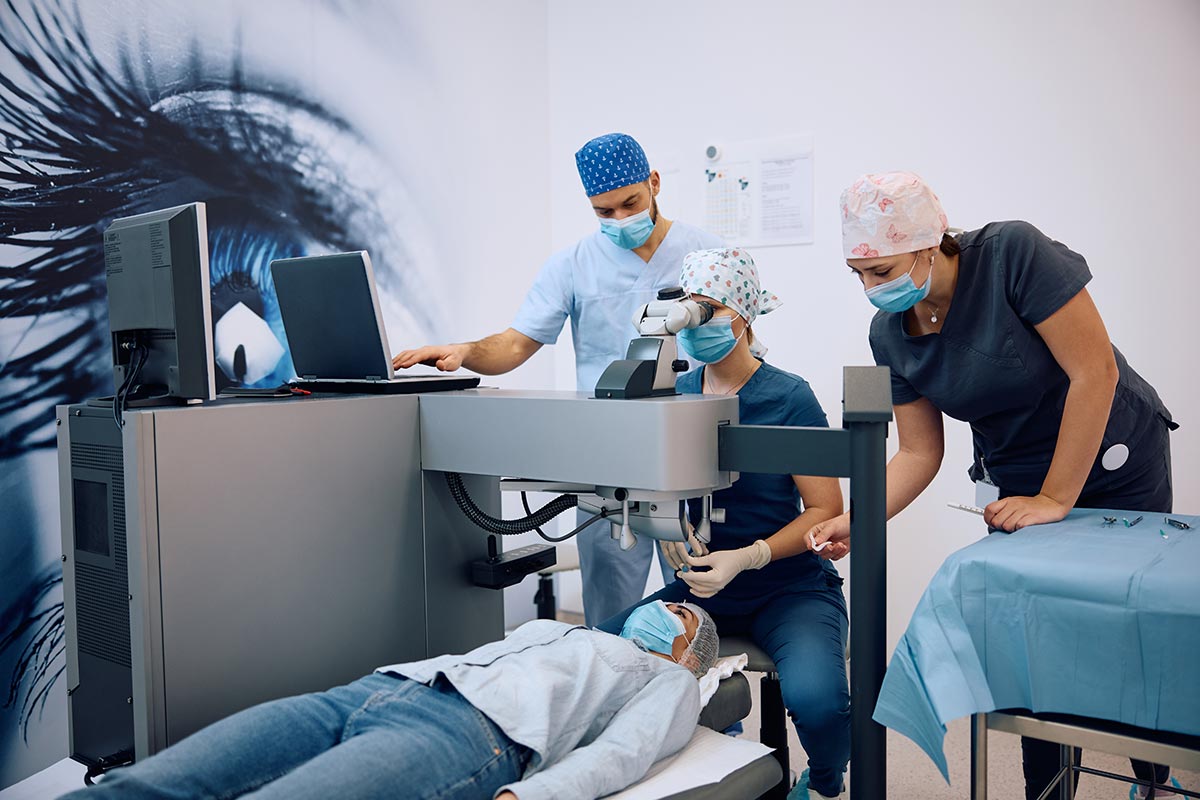
YAG Laser Capsulotomy
After cataract surgery, your new lens implant sits within a thin, clear membrane called the capsule. In the months or years that follow, the back of that capsule can gradually become cloudy, a condition known as posterior capsule opacification. When it does, vision can become blurry or hazy again and glare may return, which sometimes leads patients to think their cataract has come back.
A YAG laser capsulotomy creates a small opening in the center of the cloudy capsule, allowing light to pass through clearly once more. The treatment is painless, requires no incisions, and typically takes only a few minutes in the office.
Most patients notice their vision sharpen within a day, and because the treated area does not cloud again, it is usually a one-time procedure.
YAG Peripheral Iridotomy (PI)
In some eyes, the angle where fluid normally drains is unusually narrow. This can slow or block the circulation of fluid inside the eye and, in certain cases, cause pressure to rise suddenly, a serious situation known as angle-closure glaucoma. A YAG peripheral iridotomy creates a tiny opening in the outer edge of the iris, giving fluid an additional pathway to move freely within the eye. This helps relieve and prevent the dangerous pressure spikes associated with narrow angles.
YAG Laser Vitreolysis
Floaters are small clumps or strands within the vitreous, the gel-like substance that fills the back of the eye. They cast shadows on the retina and appear as drifting spots, cobwebs, or threads in your field of vision. Most floaters are harmless and fade from awareness over time, but some are large or positioned in a way that meaningfully interferes with daily vision.
YAG laser vitreolysis can help select patients by using laser energy to break apart these bothersome floaters or reduce them to smaller, less noticeable pieces. Not every floater is suitable for treatment, so a careful evaluation is essential to determine whether this approach is right for you.
Your surgeon will assess the type, size, and location of your floaters before recommending the procedure.
Selective Laser Trabeculoplasty (SLT)
Selective laser trabeculoplasty is a widely used treatment for lowering eye pressure in patients with open-angle glaucoma or elevated pressure. It works by applying gentle, low-energy laser light to the trabecular meshwork, the eye’s natural drainage tissue, which stimulates the eye to improve its own fluid outflow. The word selective refers to the way the laser targets specific cells while leaving the surrounding tissue undisturbed, which is part of what makes it well tolerated and repeatable. SLT is performed in the office and can reduce a patient’s reliance on daily pressure-lowering drops. The full effect develops gradually over several weeks, and the treatment can be repeated in the future if needed.
Focal Retinal Photocoagulation (FRP)
Focal retinal photocoagulation is a targeted laser treatment used to address specific problem areas within the retina, most often leaking blood vessels associated with diabetic eye disease. With focal treatment, the surgeon directs the laser precisely at the leaking points to seal them and reduce swelling, helping to protect the vision that remains. Because it is aimed at specific, well-defined areas, the treatment is highly focused and preserves the surrounding healthy retina.
Panretinal Photocoagulation (PRP)
Panretinal photocoagulation treats a much broader portion of the retina and is used for more advanced retinal vascular conditions, including proliferative diabetic retinopathy. In these conditions, the retina becomes starved of oxygen and responds by growing fragile, abnormal blood vessels that can bleed or lead to retinal detachment.
Rather than targeting a single spot, PRP applies many small laser spots in a scattered pattern across the peripheral retina. This reduces the eye’s demand for oxygen, which in turn encourages the abnormal vessels to shrink and helps prevent serious complications.
Because it covers a wider area, the treatment is sometimes divided across more than one session, and it is designed to protect central vision by focusing on the outer retina.
Laser Retinopexy
When a tear or hole develops in the retina, fluid can seep underneath it and lift the retina away from the back of the eye, a sight-threatening event known as a retinal detachment. Laser retinopexy uses precise laser spots to create a border of scar tissue around the retinal tear. This scarring acts like a series of tiny welds, sealing the retina to the tissue beneath it so that fluid can no longer pass through.
Retinal Laser Ablation
Retinal laser ablation is a broader category of laser treatment used for a range of selected retinal disorders. It works by using focused laser energy to treat or remove abnormal or diseased areas of retinal tissue, and the specific approach is tailored to the condition being addressed.
Because retinal diseases vary so widely, this type of treatment is always guided by the recommendation of your retina specialist, who will determine whether laser ablation is appropriate and how it fits into your overall care.
If your eye doctor has recommended a laser procedure, or you would like to learn more about your options, we are glad to help. Contact Quantum Eye Surgery Center to schedule an appointment and find the treatment that fits your needs.